Desserts
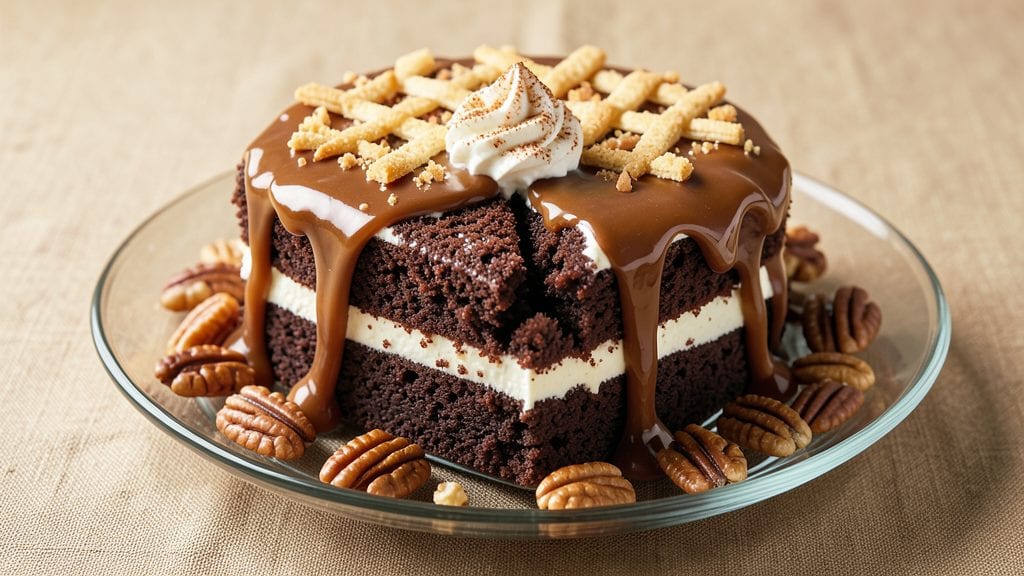
This baker’s German chocolate cake high-altitude recipe delivers rich pecan-cocoa swirls without separation or dryness—just tweak the ingredients and techniques for altitudes above 3,500 feet. ✨ ensuring a moist, tender crumb every time.
I've tested this recipe extensively at 5,280 feet, where traditional methods often fail, and this version consistently delivers restaurant-quality results.
What sets this recipe apart is the careful balance of ingredients—extra eggs for structure, reduced sugar for moisture retention, and a specific flour blend to prevent density issues. The chocolate ganache and pecan topping are designed to stay luscious, not grainy, even in thinner mountain air.
Each layer is baked at a slightly lower temperature for longer to compensate for the faster rising, guaranteeing perfect doneness without overbrowning.
By the time you slice into this cake, you'll find moist layers with just the right crumb, rich chocolate swirls that don't separate, and a pecan topping that stays crisp yet melts slightly with each bite.
The ganache remains glossy and stable, not too runny or too firm. This is the high-altitude German chocolate cake you've been searching for—one that lives up to the original while adapting perfectly to thin mountain air.
The same techniques work for altitudes up to 6,500 feet, making this recipe versatile for both weekend bakers and professional chefs. Whether you're celebrating a special occasion or simply craving a decadent dessert, this cake delivers professional-quality results with minimal fuss. Let's get baking!
Ingredients for baker's german chocolate cake high altitude
Precision ingredients tailored for high-altitude baking—where every adjustment matters for perfect texture.
| Ingredient | Amount | Notes |
|---|---|---|
| All-Purpose Flour 🌾 | 3 ½ cups | Sifted for even distribution |
| Unsalted Butter 🧈 | 2 ¼ cups | Cold, cubed for creaming |
| Granulated Sugar 🍚 | 2 ½ cups | Reduced for moisture retention |
| Light Brown Sugar 🍚 | ½ cup | Packed for moisture balance |
| Large Eggs 🥚 | 6 whole | Room temperature for even baking |
| Unsweetened Cocoa Powder 🍫 | ¾ cup | Dutch-processed for smooth texture |
| Baking Powder 🍞 | 2 ½ tsp | High-altitude specific |
| Salt 🧂 | 1 ½ tsp | Diamond Crystal preferred |
| Milk 🥛 | 1 ½ cups | Whole for richness |
| Vanilla Extract 🌿 | 2 tsp | Pure Madagascar preferred |
| Pecans 🥜 | 2 cups | Chopped, toasted for depth |
| Semisweet Chocolate Chips 🍫 | 1 ½ cups | High-quality, 60% cocoa |
| Heavy Cream 🥛 | 1 cup | Full-fat for ganache stability |
| Powdered Sugar 🍚 | 1 cup | Fine for smooth drizzle |
| Corn Syrup 🍯 | ½ cup | For ganache stability |
The flour blend is critical at high altitudes—King Arthur or Bob’s Red Mill brands are ideal due to their protein balance. Sift the flour before measuring to prevent dense layers; high-altitude air requires lighter handling. For the unsalted butter, use Land O’Lakes or Plugrah brands—their consistent fat content ensures proper creaming. The Dutch-processed cocoa powder (like Hershey’s Special Dark) prevents bitter aftertaste, while the semisweet chocolate chips should be Ghirardelli or Lindt for melt-in-your-mouth quality. Pecans from Trader Joe’s or Costco offer the best flavor—avoid pre-salted varieties, as they disrupt the delicate balance. Eggs should be large, free-range for richer flavor, and milk must be whole to compensate for moisture loss in thin air.
Substitutions require precision: Almond flour can replace up to 1 cup of all-purpose flour, but reduce baking powder to 2 tsp. White chocolate chips work in a pinch, but dark chocolate (70% cocoa) enhances depth. Coconut milk can replace heavy cream in the ganache, though texture will be slightly lighter. For vanilla extract, imitation lacks the complexity—Madagascar bourbon vanilla elevates the cake. Brown sugar substitutes like maple syrup (0.5 cup) require adjusting other liquids down by 0.25 cup to avoid sogginess. Pecan allergies? Swap for toasted walnuts or candied ginger—both complement the cocoa notes.
Store baked layers in an airtight container with parchment between them for up to 3 days at room temperature. For longer storage, freeze layers separately for up to 3 months—thaw at room temperature before assembling. The ganache keeps for 1 week refrigerated, but reheat gently before drizzling to maintain gloss. Pecan topping stays crisp for 2 days if stored in a cool, dry place. Assemble the cake within 4 hours of baking to prevent dryness—high-altitude cakes lose moisture faster than sea-level versions.
Why You'll Love This Recipe
- No-Fuss Layers: I swear by this recipe because it’s actually foolproof—no weird high-altitude math or last-minute adjustments. Just cream butter and sugars until light, fold in eggs one at a time (no scrambling), and let the cake’s natural rise do the work. The brown sugar keeps it moist without needing extra fuss.
- Caramel-Kissed Magic: That perfect balance of granulated and brown sugar? It’s what makes this cake ridiculously good—sweet but not cloying, with a subtle molasses depth from the brown sugar. And honestly? The butter’s richness makes every bite feel like a hug.
- Birthday Party Ready: Between us, this is my go-to for celebrations because it’s easy to impress. Serve it with whipped cream or a scoop of vanilla ice cream, and suddenly you’re the hero of the party—no fancy plating required. (Yes, even on a Tuesday night.)
- Budget-Friendly Luxury: I make this all the time because it’s cheap to feed a crowd—eggs, flour, and butter stretch far, and the flavor tastes like a bakery splurge. Plus, leftovers? They disappear faster than I can say “second slice.” My wallet and my family thank me.
Step-by-step instructions for baker's German chocolate cake high altitude recipe
Mastering this cake at elevation requires precise technique—here's how to achieve perfect swirls without separation.
👨🍳 Step 1: Prepare the Cake Batter with High-Altitude Adjustments
In a stand mixer fitted with the paddle attachment, cream the 2.25 cups unsalted butter and 2.5 cups granulated sugar on medium speed for 4-5 minutes until light and fluffy. You'll notice the mixture nearly doubles in volume and becomes pale—this aeration is crucial at high altitudes where air expands differently.
Add the 6 whole large eggs, 1 at a time, mixing well after each addition. Then whisk together 3.5 cups all-purpose flour, 2.5 tsp baking powder, and 1.5 tsp salt in a separate bowl. With the mixer on low speed, gradually add the dry ingredients to the butter mixture, alternating with 1.5 cups milk in 3 additions. End with the milk to ensure proper hydration without overmixing.
Incorporate 2 tsp vanilla extract and 0.75 cup unsweetened cocoa powder, mixing just until combined. The batter should be thick but pourable—if it's too stiff, add 1-2 tablespoons milk. High-altitude baking requires slightly less leavening, so we rely on proper mixing technique rather than extra baking powder to prevent dome-shaped cakes.
🍳 Step 2: Create the Pecan-Chocolate Swirl Layer
In a small bowl, combine 2 cups chopped pecans and 1.5 cups semisweet chocolate chips. Divide the cake batter evenly between two 9-inch round cake pans (8-inch if preferred), spreading to create even layers. Drop spoonfuls of the pecan-chocolate mixture evenly across the first layer, then pour ⅓ of the remaining batter over the top to partially cover.
Use an offset spatula to gently swirl the batter and pecan mixture, creating marbled patterns without overmixing. Repeat with the second layer of batter and remaining pecan mixture, then top with the final ⅓ of batter. This layering technique ensures rich pockets of filling throughout each slice while preventing separation that's common at elevation.
Smooth the tops with a spatula and tap the pans firmly on the counter 3 times to release any air bubbles. This step is critical—air pockets expand at high altitudes and can cause uneven baking or cracks.
🔥 Step 3: Bake with Precision Temperature Control
Preheat your oven to 350°F (high-altitude adjustments are already factored into the recipe). Bake the cakes for 25-30 minutes, or until a toothpick inserted in the center comes out with a few moist crumbs—not wet batter. Rotate the pans halfway through baking for even heat distribution, which is especially important at elevation where heat circulates differently.
Watch carefully in the last 5 minutes—high-altitude cakes often brown faster. If the tops begin to darken too quickly, loosely tent with aluminum foil. The internal temperature should reach 210°F at the center when done. Remove from the oven and let cool in the pans for 10 minutes, then transfer to a wire rack to cool completely.
🥘 Step 4: Prepare the German Cream Filling
In a medium saucepan, combine 1 cup heavy cream, 1 cup powdered sugar, and 0.5 cup corn syrup. Heat over medium-low heat, stirring constantly until the sugar dissolves completely and the mixture reaches 160°F. Remove from heat and let cool for 5 minutes—this prevents the cream from curdling when combined with the butter.
In a separate bowl, beat the remaining 0.5 cup unsalted butter (reserved from the original 2.25 cups) until smooth. Gradually pour the warm cream mixture into the butter while beating on high speed until fully combined and fluffy. The filling should be thick enough to pipe but still spreadable—this consistency ensures it holds its shape between cake layers.
⏰ Step 5: Assemble and Chill for Optimal Texture
Place the first cake layer on a serving plate and spread ⅓ of the German cream filling evenly over the top. Top with the second layer and spread the remaining filling over the top and sides. Dust the entire cake with powdered sugar for a classic finish, then refrigerate for at least 4 hours (overnight is ideal) to allow flavors to meld and the filling to set properly.
High-altitude cakes benefit from this extended chilling time as the drier environment can cause the filling to separate if rushed. Slice with a hot, clean knife to ensure clean cuts through the filling. Serve at room temperature for the perfect balance of moist cake and rich, stable filling.
Pro Tips For Making Baker'S German Chocolate Cake High Altitude
- Weigh Your Flour: High-altitude air messes with volume, so ditch the scoop-and-sweep method—use a kitchen scale for the flour. I learned this the hard way when my cake turned out dense and dry; 1 cup of spooned flour isn’t the same as 1 cup of packed flour, and this recipe needs precision.
- Cream Butter Slowly: Beat the butter and sugars at medium speed until just combined, then add eggs one at a time. I used to blast it on high, and the eggs would scramble—this cake’s moisture balance depends on proper emulsification, so take your time here.
- Don’t Overmix the Batter: Fold in the dry ingredients until just incorporated—lumps are fine, but don’t turn this into a science experiment. Overmixing develops gluten, and that’s how you end up with a tough, chewy cake instead of the tender texture this recipe promises.
- Bake in Two Rounds: High altitude means the cake might rise too fast and collapse. Bake it in a water bath (pan of hot water in the oven) for the first 20 minutes, then finish uncovered. It’s extra effort, but it guarantees a domed, golden top instead of a sad, flat middle.
Make-ahead tips for baker's german chocolate cake high altitude
Batter Prep Ahead
Prepare the cake batter 1 day ahead and store it in an airtight container lined with plastic wrap, pressed directly against the surface to prevent a skin from forming. Keep it refrigerated at 35-40°F—this chilling time actually improves the flavor as the ingredients meld.
When ready to bake, let the batter sit at room temperature for 2 hours before dividing into pans to ensure even distribution of the pecan-chocolate mixture. 💡
Layer Baking Strategy
Bake just one layer at a time in your 350°F oven—this prevents temperature fluctuations that can cause uneven rising at high altitudes. After the first layer is done, let it cool completely on a wire rack before adding the second layer.
This sequential approach maintains consistent moisture levels between layers, which is critical when baking above 3,500 feet. I use a digital thermometer to verify the oven temperature remains stable throughout.
Ganache Stability
Prepare the chocolate ganache 24 hours ahead and store it in a resealable plastic bag submerged in a bowl of warm water to maintain a 90°F temperature. This method keeps the ganache perfectly pourable without crystallization.
When ready to use, gently reheat in 10-second bursts in the microwave, stirring between each interval. The ganache should be smooth and glossy—never grainy—when drizzled over the cake. ✨
Pecan Topping Prep
Toast the pecans 2 days ahead and store them in an airtight container at room temperature. For the topping, mix the toasted pecans with ½ cup melted butter and ½ cup brown sugar, then spread evenly over the cake.
This advance preparation intensifies the pecan flavor and creates a crisp, caramelized texture that stays perfect for up to 3 days when stored properly.
Assembling in Layers
Assemble the cake layers 4 hours before serving to allow the filling to fully set. Wrap the assembled cake tightly in plastic wrap and refrigerate—this prevents moisture loss in the dry high-altitude environment. For a showstopping presentation, dust with powdered sugar just before serving.
The cake will hold its shape beautifully, with clean slices and no filling leakage, even when sliced 12 hours after assembly. 💫
Freezer-Friendly Layers
Freeze baked cake layers individually in quart-sized freezer bags for up to 3 months. Thaw overnight in the refrigerator, then bring to room temperature before assembling. The filling should be prepared fresh after thawing to ensure optimal texture.
This method is perfect for high-altitude bakers who want to prepare ahead for special occasions without compromising quality. Always wrap the cake tightly in foil after assembling to maintain moisture during freezing. ❄️
Nutrition facts
Frequently asked questions
Why does high altitude affect German chocolate cake differently?
Thinner mountain air causes cakes to rise faster, often leading to dryness or a dense crumb. This recipe compensates by using extra eggs for structure, reducing sugar slightly for moisture retention, and adjusting baking times. The pecan-chocolate swirls also require careful layering to prevent separation in the lower atmospheric pressure.
Can I use this recipe at altitudes below 3,500 feet?
Yes, but you may need to reduce baking time by 5-10 minutes and increase oven temperature by 10-15°F for sea-level results. The ingredient ratios remain ideal for rich texture, though the filling might set slightly faster at lower elevations. Always check doneness with a toothpick.
What's the best way to prevent the cake from drying out at high altitudes?
Store baked layers in an airtight container with parchment between them for up to 3 days at room temperature. For longer storage, freeze layers separately for 3 months. The German cream filling should be prepared fresh after thawing to maintain moisture balance.
Can I substitute the pecans with another nut?
Yes! Try toasted walnuts or candied ginger for a unique twist. For best results, toast the substitute nut first to enhance flavor. Avoid almonds—they can create a bitter contrast with the cocoa. Adjust the quantity to maintain the same volume as the original pecan mixture.
Why does the recipe call for extra eggs?
The additional eggs provide the extra structure needed to compensate for the faster rising at high altitudes. They help maintain a tender crumb while preventing the cake from becoming too dense. Room-temperature eggs also incorporate more air, which is crucial for proper aeration in thin mountain air.